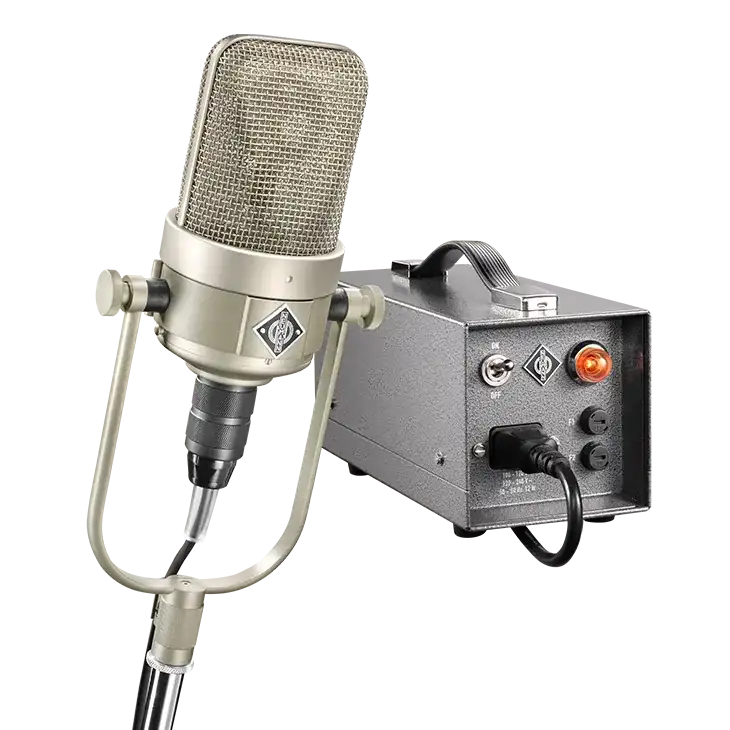
M 50 V Set
Tube Microphone
From Neumann:
Introduced in 1951, the M 50 became the benchmark in classical recording and was instrumental in developing the Decca Tree technique, thanks to its outstanding transient response and unique polar pattern. While omnidirectional at low frequencies, the M 50 becomes gradually more directional at high frequencies. The M 50 V is a faithful reissue according to original specifications, using documentation from the Neumann archive.
Developed in close cooperation with Nordwestdeutscher Rundfunk (Northwest German Broadcasting), the M 50 was the counterpart to the no less legendary M 49. While the latter was a high-quality all-purpose microphone for varying acoustic environments, the M 50 was designed as the ultimate pressure transducer microphone for use in concert halls and dedicated recording spaces.
In practice, this meant that the M 50 was mainly used for recording orchestras, e.g. as the main pickup in various spaced omni configurations. In the 1950s, when the record label Decca experimented with stereo miking techniques, various setups, microphones, and pickup patterns were tried. In the end, the Neumann M 50 was selected as the perfect fit for what is now known as the Decca Tree configuration, i.e. three microphones mounted in a triangle with the outer microphones facing outward. To this day, a Decca Tree setup, often extended with additional outriggers, using Neumann M 50 microphones remains the prime choice for experienced engineers in classical music and film scores. The vivid imaging of this setup in combination with the M 50’s outstanding resolution produces unparalleled results. Today, extended versions of this technique are being used for surround and immersive recordings. Of course, the M 50 has also produced excellent results in other applications, e.g. piano recordings or as a spot mic for string sections and soloists. In pop contexts, the M 50 has been used for miking ensembles or brass sections and as a room microphone, e.g. on drums.
Specs
- Operating principle
- Pressure transducer
- Pattern
- Omni
- Frequency range
- 20 Hz – 16 kHz
- Sensitivity (1 kHz into 1 kohm)
- 19 mV/Pa ≅ -34.5 dBV ± 1 dB
- Output impedance (rated)
- 200 ohms
- Rated load impedance
- 1000 ohms
- Self-noise, A-weighted
- 15 dB-A
- Self-noise, CCIR
- 27 dB
- Signal-to-noise ratio, A-weighted (re. 94 dB SPL)
- 79 dB
- Signal-to-noise ratio, CCIR (re. 94 dB SPL)
- 67 dB
- Maximum SPL (THD 0.5%)
- 118 dB SPL
- Maximum output voltage
- –8 dBu
- Power supply
- NM V
- Connector, microphone
- KC 5 cable (7-pin)
- Connector, power supply output
- XLR 3 F
- Diameter
- 80 mm
- Length
- 163 mm
- Weight
- 800 g
- Finish
- nickel
- Included
- 1x M 50 V, 1x NM V Pattern Control Unit, 1x KC 5 Cable, 1x MZ 49 A Shock Mount, 1x M 50 V Case, 1x Safety Guide, 1x Quick Guide
Source: Neumann M 50 V Set product page